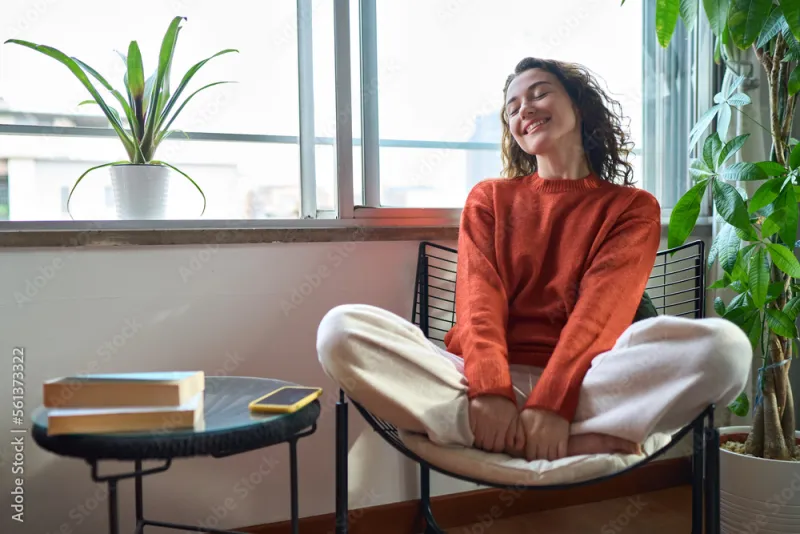
The Glow-Up Nobody Talks About: What Happens When You Finally Stop Fighting Your Own Face
I was twenty-nine years old the first time I looked in the mirror and genuinely liked what I saw. Not in a "good lighting, good angle" way. Not in a "I did a full face and I look put-together" way. Just... me, at 7 a.m., slightly puffy, with my hair doing whatever it wanted, and I thought: okay, yeah, that's fine. That's actually fine.
It sounds like such a small thing. It wasn't.
For most of my teens and early twenties, my beauty routine was essentially an elaborate daily argument with my own face. I spent a genuinely embarrassing amount of time and money trying to flatten, smooth, cover, and correct things that, in retrospect, were just... features. My skin had texture. My hair had volume in all the wrong places. I had hyperpigmentation along my cheekbones from years of picking at my skin. I had eyebrows that refused to cooperate. And every product I bought, every tutorial I watched, was framed around the idea that these were problems to be solved.
Spoiler: they weren't problems. They were just my face.
Where These Routines Actually Come From
Here's the thing about beauty habits—most of them are formed during some of the most emotionally turbulent years of our lives. We're thirteen, fourteen, fifteen, deeply self-conscious, surrounded by peers who are equally self-conscious, and we absorb the message that our natural appearance is a rough draft that needs editing.
And then we carry those habits forward. For years. Sometimes for decades.
Think about the products you're using right now. When did you start using them? Why? For a lot of us, the honest answer is some version of: I started using this because I hated something about myself, and this product promised to fix it. A heavy-coverage foundation because a kid in seventh grade said your skin looked bad. A chemical relaxer because your natural texture was called "unprofessional." A pore-minimizing primer because you internalized the idea that visible pores were something to be ashamed of.
Those aren't skincare decisions. Those are coping mechanisms dressed up as beauty routines.
The Skin You Have Now Is Not the Skin You Had Then
Beyond the emotional archaeology, there's also just the practical reality that your skin and hair change—a lot—between your teens and your thirties, and most of us don't update our routines to reflect that.
The matte, oil-absorbing everything that kept your teenage breakouts manageable might be completely wrecking the moisture barrier of your now-drier adult skin. The heavy conditioners you used to tame thick hair in your twenties might be weighing down a texture that's shifted with hormonal changes. The same retinol concentration that was fine last year might suddenly be too aggressive for skin that's become more sensitive with age or stress.
Our skin doesn't stay the same, but our routines often do—partly out of habit, partly out of loyalty to products that once "worked," and partly because changing a routine means confronting the fact that things have changed. And that can feel surprisingly emotional.
Losing hair density. Noticing deeper expression lines. Watching hyperpigmentation shift and spread. These aren't failures. They're just time, doing what time does. But when your entire framework around beauty has been about controlling and correcting, accepting change can feel like giving up.
It's not giving up. It's growing up. There's a difference.
What "Letting Go" Actually Looks Like in Practice
I want to be clear: this isn't a piece about throwing out all your products and going fully bare-faced forever. Makeup is fun. Skincare can be genuinely pleasurable self-care. There's nothing wrong with wanting to look a certain way.
The shift I'm talking about is more about why you're doing what you're doing—and whether those reasons still make sense.
For me, it started with a single experiment. I stopped wearing foundation for two weeks. Not because I was making a statement, but because I'd run out and kept forgetting to buy more. And at first it was uncomfortable. I was hyperaware of my skin in a way that felt almost physical—like everyone could see every pore, every patch of uneven tone.
By week two, something had shifted. I'd stopped noticing. And when I eventually did put foundation on again, it felt like a choice I was making rather than armor I was required to wear.
That distinction—choice versus compulsion—is everything.
The Practical Side of Simplifying
When you strip a routine back to what your skin actually needs right now (not what it needed when you were seventeen, not what a twelve-step influencer routine tells you it needs), a few things tend to happen.
First, your skin often settles. Over-routining is genuinely a thing. Layering multiple actives, using harsh cleansers, exfoliating too frequently—all of it can compromise your skin barrier, leading to increased sensitivity, breakouts, and redness. Sometimes the "skin problems" you've been fighting for years are actually routine-induced.
Second, you start to notice what your skin is actually doing, rather than just managing it. You realize your skin is drier in winter and needs more moisture. You notice that your hair texture has changed and maybe your old shampoo isn't serving it anymore. You start to respond to your skin instead of running a fixed program at it.
Third—and this is the part that surprised me most—you start spending less. Not because you've become minimalist for minimalism's sake, but because you're buying intentionally. You're not panic-buying every new product that promises to fix something you've decided you need to fix. You're just... maintaining. Tending. It's a different energy entirely.
The Liberation Nobody Warned You About
There's a version of this story that ends with me telling you I have perfect skin now and I never think about it. That would be a lie. I still have days where I look in the mirror and feel the old critical voice start up. I still have products I reach for when I want a little extra something. I'm not immune to the beauty industry's very sophisticated ability to make me feel like I'm lacking.
But the difference is that I'm no longer trying to win a war against my own face. I'm not trying to correct it into something it's not. My skin has texture, and that's fine. My hair does what it wants on humid Brooklyn summers, and that's fine too. The hyperpigmentation along my cheeks has faded some with time and a targeted vitamin C serum I genuinely like using—not because I hate my face, but because I wanted to try it.
That's the glow-up nobody really talks about. Not the one where you find the perfect routine and achieve some idealized version of yourself. The one where you look at your actual face, with all its changes and quirks and history, and decide it's worth working with instead of against.
It took me way longer than it should have to get there. But honestly? It was worth the wait.